Article-At-A-Glance:
- Children and teens who spend more than 3 hours daily on social media face double the risk of depression and anxiety symptoms.
- Social media algorithms are engineered to maximize engagement—not protect your emotional well-being.
- Limiting social media to just 30 minutes a day has been shown to significantly reduce anxiety, loneliness, and FOMO within two weeks.
- 46% of teens aged 13–17 say social media makes them feel worse about their bodies—and the research behind why is more alarming than most people realize.
- There are proven, practical strategies to reclaim control of your mental health without deleting your accounts entirely.
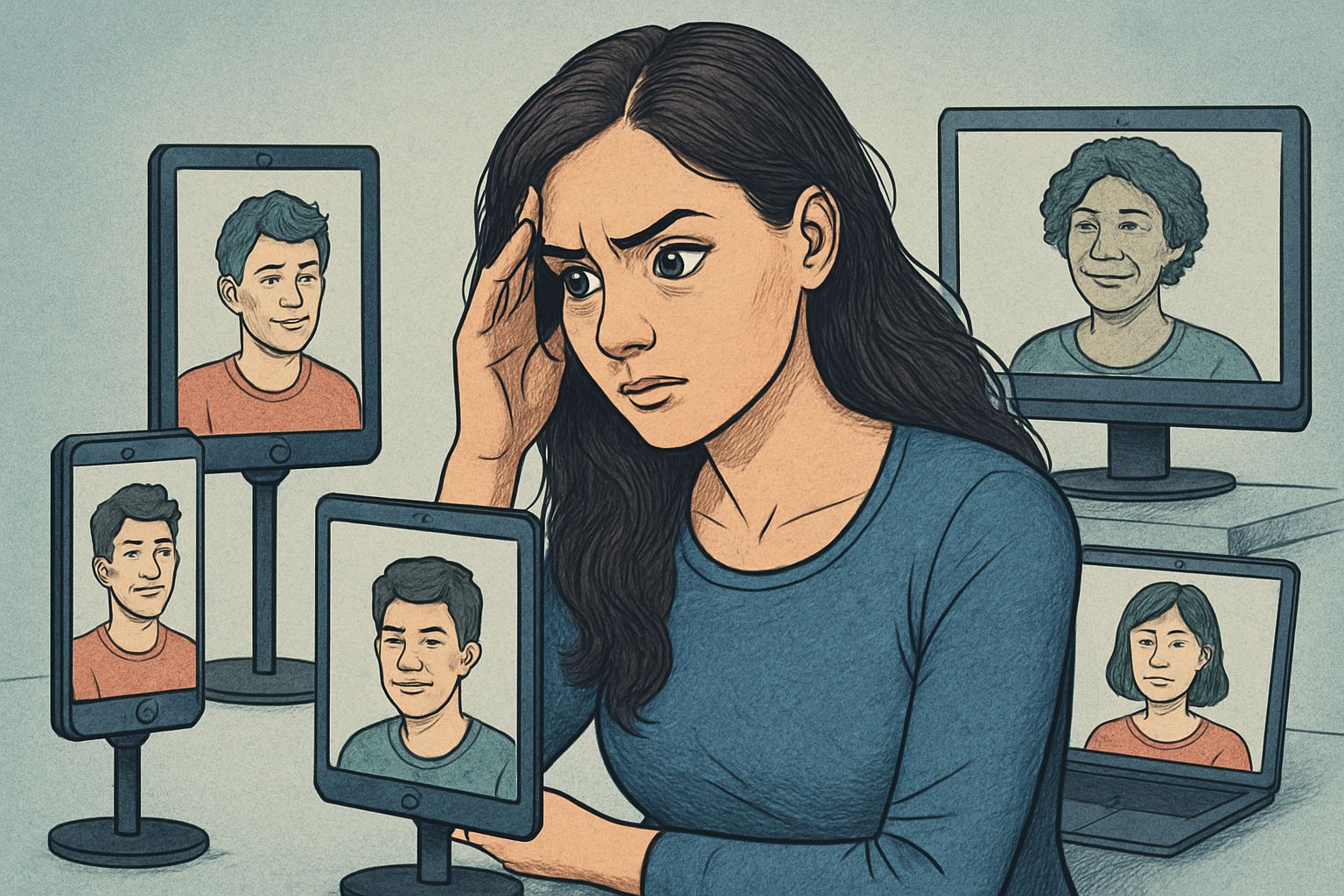
Social media was built to connect people—but the way it actually works can quietly pull your mental health apart.
Most of us scroll without thinking twice about what’s happening beneath the surface. The feeds feel organic, the content feels relevant, and the time disappears. But what you see online is not a neutral reflection of reality. It’s a carefully engineered selection of content designed to keep you engaged as long as possible—and that distinction matters enormously for your mental health.
Understanding how social media shapes your mind is the first step toward using it on your own terms. Whether you’re a parent concerned about a teenager, a young adult who feels worse after every scroll session, or simply someone who senses something is off, this article breaks down exactly what the research says—and what you can actually do about it.
Social Media Is Designed to Distort Reality—Here’s What That Does to Your Mind
Social media platforms are not passive tools. Every major platform—Instagram, TikTok, Facebook, X (formerly Twitter)—uses machine-learning algorithms that study your behavior in real time. What you pause on, what you like, what makes you scroll back up. The goal is simple: keep you on the platform longer. The side effect? Your feed becomes an increasingly distorted version of reality, curated to trigger emotional reactions rather than reflect actual life.
This distortion has real psychological consequences. When your brain repeatedly encounters idealized images, outrage-inducing headlines, and carefully staged moments presented as everyday life, it begins to use that content as a benchmark for normalcy. That’s where the damage starts.
How Social Media Algorithms Manipulate What You See
The algorithm is not your friend—it’s a retention engine. It doesn’t care whether the content it shows you makes you feel good or bad. It cares whether that content makes you react. Anger, envy, validation, and fear are some of the most powerful engagement triggers, and platforms have learned to exploit all of them.
Algorithms Prioritize Emotionally Charged Content Over Accurate Content
Content that provokes a strong emotional response gets amplified—full stop. A post showing someone’s perfect vacation, an outrage-inducing political take, or a body transformation photo will consistently outperform balanced, nuanced content in algorithmic ranking. This creates what researchers describe as an emotional bias loop: the more extreme the content, the more it spreads, the more you see it.
This isn’t accidental. Emotionally activated users click more, share more, and stay longer. For the platform, that translates directly to ad revenue. For you, it translates to a feed that consistently skews toward content that destabilizes rather than informs.
Doomscrolling: How Negative Content Becomes a Habit
Doomscrolling—the act of continuously consuming negative news or distressing content—is a direct product of how algorithms work. Once you engage with one piece of upsetting content, the algorithm interprets your reaction as interest and serves you more of the same. Over time, this creates a habitual loop where negative content dominates your feed, and your brain becomes conditioned to seek it out even when it causes distress. It becomes a compulsion disguised as staying informed.
Comparison Culture and the Curated Highlight Reel
Nobody posts their worst days. What you see on Instagram or TikTok is almost always the best version of someone’s life—the trip, the promotion, the glowing skin, the perfect relationship. Algorithms amplify this further by prioritizing aspirational content because it drives higher engagement. The result is that your feed becomes a non-stop highlight reel of other people’s peaks compared against the full, messy reality of your own life. That comparison is inherently unfair—and consistently doing it takes a measurable toll on self-esteem and mood. To better understand this, you might explore the power of acceptance and how it can help mitigate these effects.
The Real Mental Health Risks of Too Much Social Media
The connection between heavy social media use and poor mental health is no longer a theory. It’s documented across multiple studies, age groups, and platforms. Here’s what the data actually shows.
Children and Teens Face Double the Mental Health Risk at 3+ Hours Per Day
Children and adolescents who spend more than 3 hours a day on social media face double the risk of mental health problems, including depression and anxiety. This is especially alarming when you consider that the average teenager now spends approximately 3.5 hours per day on social media—putting the majority of teens squarely in the high-risk category without most parents even realizing it. To understand more about the psychological factors influencing these behaviors, explore what drives our decisions.
The U.S. Surgeon General has issued an advisory specifically addressing social media and youth mental health, calling for a coordinated effort to identify which types of content are most harmful and what protective factors can buffer young people against these effects. The concern at that level of public health leadership signals just how significant this issue has become.
46% of Teens Say Social Media Makes Them Feel Worse About Their Bodies
Body image is one of the most direct casualties of social media use among adolescents. When surveyed, 46% of teenagers aged 13–17 reported that social media makes them feel worse about their own bodies. This isn’t a vague sense of dissatisfaction—it’s a measurable shift in self-perception driven by constant exposure to filtered, edited, and algorithmically amplified images of physical appearance.
By the numbers: Social Media & Teen Mental Health
Metric
Finding
Daily average screen time (teens)
3.5 hours on social media
Mental health risk threshold
3+ hours/day doubles the risk of depression & anxiety
Teens reporting negative body image
46% of ages 13–17
Reduction in anxiety with time limits
30 min/day limit significantly reduced anxiety, depression, loneliness & FOMO within 2 weeks
The pattern is consistent: the more time teens spend on image-focused platforms, the more distorted their sense of their own worth and appearance becomes. And for a demographic already navigating enormous developmental pressure, that added layer of comparison can be genuinely destabilizing.
Dopamine, Dependency, and the Anxiety Loop
Every notification, like, and comment triggers a small release of dopamine—the brain’s reward chemical. Social media platforms are deliberately designed to exploit this mechanism. The unpredictable nature of social validation (sometimes you get lots of likes, sometimes none) mirrors the same variable reward system used in slot machines. Over time, your brain begins to crave that hit, creating a dependency cycle where checking your phone feels compulsive rather than intentional.
When the expected reward doesn’t come—when a post gets little engagement, or when scrolling leaves you feeling empty—anxiety fills the gap. This loop of anticipation, reward, and withdrawal is one of the key reasons heavy social media users report higher baseline anxiety levels, even when they’re not actively using their devices. For more insight into this cycle, you might explore the role of dopamine in our behavior.
Does Deleting Social Media Actually Help?
The short answer is yes—but the details matter more than the headline.
Research consistently shows that stepping away from social media produces measurable improvements in mood, anxiety levels, sleep quality, and overall well-being. But the benefits aren’t uniform across all platforms, age groups, or usage patterns. Whether you’re considering a permanent delete or just a temporary detox, understanding what the evidence actually says will help you make a decision that works for your specific situation.
It’s also worth noting that not all social media use is harmful. The problem isn’t the platforms themselves in every case—it’s the type of use, the amount of time, and the content being consumed. Passive scrolling through comparison-heavy content is fundamentally different from actively messaging a close friend or joining a community around a shared interest you genuinely care about.
Before deciding whether to delete, deactivate, or simply limit your use, consider what your current relationship with social media actually looks like. Ask yourself:
- Do you reach for your phone within minutes of waking up?
- Do you feel anxious or irritable when you can’t check your apps?
- Does scrolling usually leave you feeling better or worse than before you started?
- Are you using social media to connect, or mostly just to consume?
- Has your sleep been disrupted by late-night scrolling?
A Two-Week Break Significantly Reduced Depression Symptoms Across Multiple Studies
One of the most cited findings in this space involves students who were asked to limit their social media use to just 30 minutes per day for two weeks. The results were striking: participants reported significantly lower levels of anxiety, depression, loneliness, and FOMO (fear of missing out) compared to those who continued their normal usage habits. Two weeks. Thirty minutes a day. That’s how quickly the psychological environment can shift when you reduce the input.
What makes this finding particularly actionable is that participants didn’t delete their accounts. They simply imposed a daily cap. That’s a meaningful distinction—it means you don’t have to go to extremes to see real mental health benefits. A modest, consistent limit can create genuine breathing room for your nervous system to reset.
The Risks of Going Cold Turkey on Social Media
Deleting social media entirely isn’t the right move for everyone. For some people, these platforms are a genuine source of community, professional connection, or access to support networks that don’t exist offline. Abruptly removing that connection without replacing it with something else can lead to increased feelings of isolation—particularly for individuals who already struggle with loneliness or limited in-person social support.
If you’re considering a full break, treat it like any other significant behavioral change: plan for it. Identify what needs social media currently meets for you, and have a realistic alternative in place before you step away. A 3–7 day deactivation as a trial period is a lower-stakes starting point than a permanent delete, and it gives you real data about how your mood and focus shift without the pressure of a permanent commitment.
5 Practical Strategies to Protect Your Mental Health on Social Media
You don’t have to choose between being connected and being mentally healthy. What you do need is an intentional approach—because the default settings on every major platform are optimized for the platform’s benefit, not yours.
The strategies below are grounded in research and ordered by impact. Some are quick wins you can implement today. Others require more sustained effort but produce deeper, longer-lasting change. None of them require you to delete your accounts or disconnect from the people and communities that matter to you.
Think of your social media use the way you’d think about your diet. The goal isn’t perfection or total elimination—it’s making conscious choices about what you consume, how much, and why. The following strategies give you a practical framework for doing exactly that.
Quick Reference: Strategies to Protect Your Mental Health on Social Media
Strategy
Primary Benefit
Effort Level
Set daily time limits (15–30 min)
Reduces anxiety, depression & FOMO
Low
Curate your feed
Reduces negative comparison triggers
Low
Add friction to scrolling
Breaks compulsive checking habits
Low
Engage with purpose
Increases positive connection
Medium
Create online/offline boundaries
Improves sleep & focus
Medium
Report cyberbullying & harassment
Reduces acute emotional harm
Medium
Know when to call for help
Crisis prevention
Critical
1. Set Daily Time Limits of 15–30 Minutes
This is the single highest-impact change most people can make immediately. Both iOS and Android have built-in screen time management tools—Screen Time on iPhone and Digital Wellbeing on Android—that let you set hard daily limits on individual apps. Once the limit is hit, the app locks until the next day. Set it, and don’t give yourself the override passcode.
The research backs this up clearly. Limiting social media to 30 minutes per day produced significant reductions in anxiety, depression, loneliness, and FOMO within just two weeks. You don’t need to go lower than that to see results—30 minutes is enough to stay connected without falling into the compulsive scroll cycle that drives most of the harm.
If 30 minutes feels impossible right now, start with wherever you currently are and reduce by 20–30% each week. The goal is gradual, sustainable reduction—not white-knuckling your way through a restriction that’s so severe it collapses on day three.
2. Curate Your Feed by Unfollowing Negative Triggers
Your feed is not fixed. You have direct control over what appears there, and exercising that control is one of the most psychologically protective things you can do. Unfollow accounts that consistently make you feel inadequate, anxious, or angry. Mute topics or keywords that spike your stress levels. Actively seek out and follow accounts that provide genuine value—education, humor, creativity, or authentic community. The algorithm will learn from your new behavior and adjust accordingly. Within a week or two, your feed will look dramatically different.
3. Add Friction to Reduce Mindless Scrolling
Mindless scrolling thrives on zero resistance. The apps are designed to be frictionless—one tap and you’re in. Adding small barriers between you and the app can break that automatic behavior more effectively than willpower alone. Log out of apps after every session so you have to manually sign back in. Move social media apps off your home screen and into a folder buried on a secondary page. Delete the apps from your phone entirely and only access them through a browser, which is a less optimized experience. These micro-frictions sound minor, but they consistently interrupt the reflex-based checking that accounts for a large portion of most people’s daily usage.
4. Engage With Purpose, Not Out of Habit
There’s a meaningful difference between active and passive social media use—and that difference shows up in mental health outcomes. Active use means messaging a friend, commenting on something meaningful, sharing something you genuinely want to share. Passive use means scrolling without direction, consuming content without interacting, and checking notifications out of reflex rather than intent. Understanding the psychology behind choices can help you engage more purposefully.
Research consistently shows that passive use is the driver of most social media-related mental health harm. Active, purposeful engagement—especially when it involves genuine social connection—can actually support well-being rather than undermine it. Before you open an app, ask yourself what you’re actually there to do. If you don’t have a clear answer, that’s a signal to put the phone down.
One practical approach is to set a specific intention before each session. “I’m going to check in with three friends” or “I’m going to share this article” is a fundamentally different mental posture than opening Instagram with no particular goal and surfacing forty minutes later feeling vaguely hollow.
5. Create Clear Boundaries Between Online and Offline Time
One of the most effective structural changes you can make is building defined no-phone zones into your day—and protecting them consistently. The most impactful ones for mental health are the hour before bed and the first 30 minutes after waking. Late-night social media use directly disrupts sleep quality by suppressing melatonin production through blue light exposure and keeping your nervous system activated when it should be winding down. Starting your morning with social media primes your brain for reactivity and comparison before you’ve had a chance to establish your own internal baseline for the day.
Meals, time with family, and any activity that requires genuine presence are also worth protecting as offline zones. The cumulative effect of these boundaries is significant—not just for reducing social media’s negative impact, but for rebuilding the capacity for sustained attention and in-person connection that heavy social media use tends to erode over time.
If Social Media Is Hurting You, Real Help Exists
Feeling worse after using social media isn’t a personal failure or a sign of weakness—it’s a predictable response to platforms that are engineered to exploit psychological vulnerabilities. The fact that millions of people experience anxiety, depression, and low self-worth as a result of social media use is not a coincidence. It’s the outcome of design decisions made by billion-dollar companies optimizing for engagement above all else.
Recognizing that the system is working against you is an important first step. But recognition alone doesn’t resolve the harm. If your mental health is being consistently affected by social media use—if you’re experiencing persistent low mood, anxiety that spikes when you check your phone, disrupted sleep, disordered thinking about your body, or withdrawal-like symptoms when you try to step back—it’s worth talking to a mental health professional. A therapist can help you untangle what’s driven by social media and what may have deeper roots, and give you tools that go beyond app timers and feed curation.
You can also visit engage.youth.gov to access a Tip Sheet on Social Media Use and Mental Health, created for and by young people. For parents navigating this with a child or teenager, the U.S. Surgeon General’s Advisory on Social Media and Youth Mental Health is a substantive, research-grounded resource worth reading in full. The bottom line is this: help exists, the problem is real, and you don’t have to manage it alone.
Frequently Asked Questions
Below are answers to the most common questions people ask about social media and mental health—answered directly, without the noise.
How does social media negatively affect mental health?
Social media negatively affects mental health through several overlapping mechanisms. Algorithms amplify emotionally charged and comparison-heavy content, which distorts your perception of reality and other people’s lives. Passive scrolling triggers a dopamine-reward cycle similar to gambling, creating compulsive checking behaviors and baseline anxiety. Exposure to idealized images damages body image and self-esteem, particularly in teenagers. And the constant availability of online interaction erodes the boundaries between rest and stimulation, disrupting sleep and reducing the capacity for sustained in-person connection.
The harm isn’t evenly distributed. Teenagers, particularly girls on image-focused platforms like Instagram, show the strongest negative associations. Heavy users—those exceeding 3 hours per day—face measurably higher rates of depression and anxiety than moderate or light users. The type of use matters too: passive consumption is significantly more harmful than active, purposeful engagement with people and communities you genuinely care about.
How much social media use is too much for teenagers?
Research identifies 3 hours per day as the threshold at which mental health risk doubles for children and adolescents. Given that the average teen currently spends approximately 3.5 hours per day on social media, the majority of teenagers are already in the high-risk zone. The recommended approach is not necessarily zero social media use, but rather intentional, limited, and actively monitored use—particularly for teens under 16.
Parents play a critical role here. Open, non-judgmental conversations about what teens are seeing and feeling online are more effective than outright bans, which often drive usage underground. Collaborative limit-setting—where teens are part of establishing the rules—produces better long-term compliance and builds the self-regulation skills that carry into adulthood.
Can taking a break from social media improve your mental health?
Yes—and the research is consistent on this point. Even modest reductions in social media use produce measurable improvements in mental health outcomes within a relatively short time frame. You don’t need to delete your accounts permanently to feel the difference.
Studies show that limiting use to 30 minutes per day for just two weeks led to significant reductions in anxiety, depression, loneliness, and FOMO among student populations. A separate five-week deactivation study found improved overall well-being and reduced depression—with the strongest effects in Facebook users over 35 and Instagram users under 25. The key variables that influence how much benefit you’ll see include:
- Duration of the break: Even 3–7 days produces noticeable mood improvement for many people
- Platform type: Image-heavy platforms like Instagram tend to produce stronger negative effects and correspondingly stronger relief when removed
- What replaces the time: Physical activity, in-person social connection, and sleep amplify the benefits significantly
- Your baseline usage level: Heavy users typically notice the most dramatic improvement in the first week off
- Whether you replace connection: If social media is your primary social outlet, stepping away without a plan can increase isolation
A trial deactivation of one week is a low-stakes way to gather real data about how your mood, focus, and sleep change without the pressure of a permanent decision. Pay attention to how you feel at the end of each day during the break—your own experience is the most relevant data point you have.
What is the healthiest way to use social media?
The healthiest social media use is intentional, time-limited, and actively curated. It means logging on with a specific purpose rather than out of habit or boredom, engaging actively with people rather than passively consuming content, and regularly auditing your feed to remove accounts that consistently produce negative emotional responses.
From a time standpoint, keeping daily use at or under 30 minutes is the threshold most consistently associated with neutral-to-positive mental health outcomes. This doesn’t mean every session needs to be exactly 30 minutes—it means your total daily exposure should stay within that range as a general guide. Using app timers, logging out after each session, and keeping social media apps off your home screen all support staying within that boundary without relying on willpower alone.
It’s also worth being honest about which platforms serve you and which ones don’t. Not all social media is equal. A private group chat with close friends is a fundamentally different experience than an algorithmic feed of strangers’ highlight reels. Protecting time for the former while limiting exposure to the latter is one of the most practical distinctions you can make. If you’re struggling with this, consider exploring the power of acceptance to help manage your social media habits.
Healthy vs. Unhealthy Social Media Habits at a Glance
Healthy Habit
Unhealthy Habit
Logging on with a clear intention
Opening apps out of boredom or reflex
Actively messaging or commenting
Passively scrolling without interacting
Unfollowing accounts that trigger comparison
Following accounts that make you feel inadequate
Setting a 30-minute daily limit
Unlimited, untracked daily use
Phone-free time before bed and after waking
Scrolling in bed first and last thing daily
Taking regular breaks (weekly or monthly)
Never stepping back to assess how it’s affecting you
What should I do if social media is making me feel depressed or anxious?
Start by reducing your exposure immediately—even a 3-day break can create enough distance to help you identify how much of your current mood is being driven by what you’re seeing online. Use that time to sleep more, move your body, and spend time with people in person if you can. These aren’t vague wellness suggestions—they’re the specific behaviors most consistently shown to counteract the neurological effects of heavy social media use.
If the feelings persist beyond a break, or if they’re severe enough to interfere with your daily functioning, relationships, or sense of self-worth, it’s time to talk to a mental health professional. A therapist who works with technology and behavioral issues can help you build a sustainable relationship with social media that doesn’t come at the cost of your well-being. If cost or access is a barrier, community mental health centers, school counselors, and telehealth platforms have expanded significantly in recent years and offer lower-cost entry points to professional support. Additionally, understanding your attachment styles can be beneficial in addressing personal issues.
And if you are ever in crisis—if the thoughts go beyond feeling low and move toward hopelessness or self-harm—call or text 988 right now. You don’t have to be certain it qualifies as a crisis to reach out. If it feels serious, it is serious enough to make the call. Understanding the power of acceptance can also be a crucial step in dealing with difficult emotions.